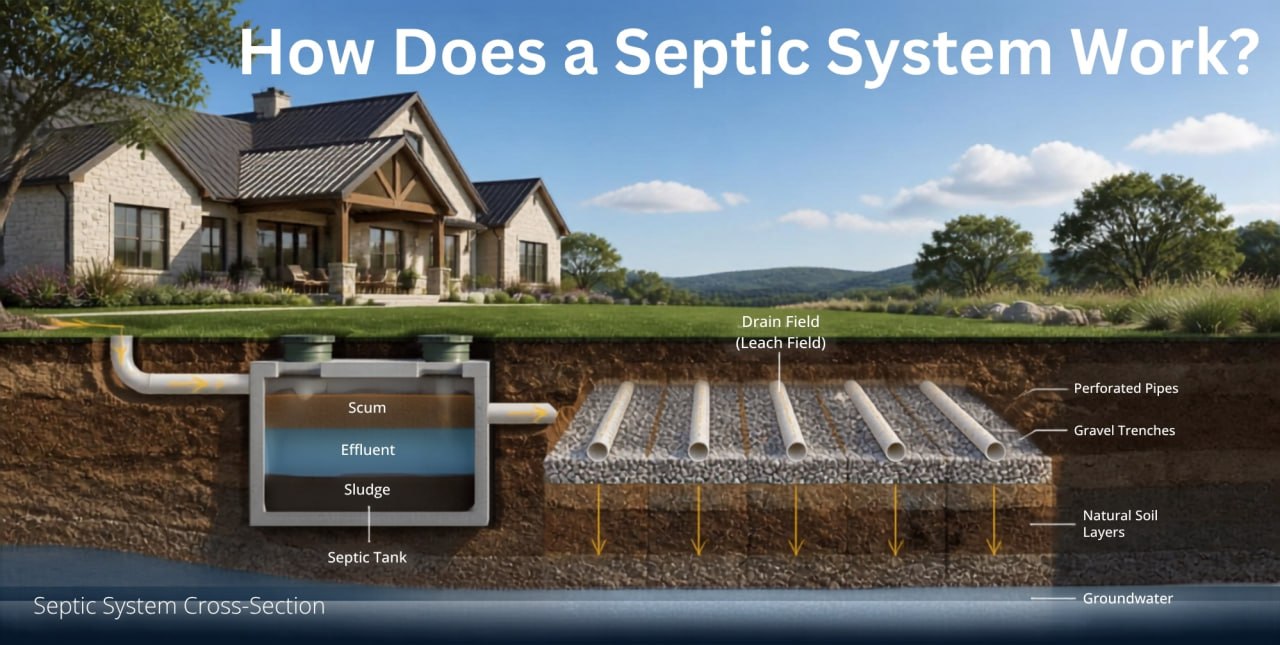
If you just bought a home with a septic system — or you're building one — you might be wondering what exactly is going on underground. It's one of those things most people never think about until something goes wrong. But understanding the basics can save you a lot of money and headaches down the road.
Let's walk through it in plain English.
The Three Main Parts
Every septic system has three core components that work together: the septic tank, the drain field (also called a leach field), and the soil underneath. Think of it as a team — each part has a job, and if one fails, the whole system suffers.
1. The Septic Tank
When you flush a toilet, run the dishwasher, or take a shower, all that wastewater flows through your home's plumbing and into the septic tank. This is usually a large concrete, fiberglass, or polyethylene container buried in your yard — typically holding 1,000 to 1,500 gallons.
Inside the tank, the magic of gravity and biology goes to work. Heavy solids sink to the bottom and form a layer called "sludge." Lighter stuff like grease and oils float to the top, forming "scum." The liquid in the middle — called "effluent" — is what eventually moves on to the next stage.
Naturally occurring bacteria inside the tank break down a good portion of those solids over time. But they can't get everything, which is why you need periodic pumping (usually every 3 to 5 years).
2. The Drain Field
Once the effluent leaves the tank, it flows into the drain field — a network of perforated pipes buried in gravel-filled trenches across your yard. The liquid seeps out through those perforations and slowly filters down through layers of gravel and soil.
This is where the real treatment happens. The soil acts as a natural filter, removing harmful bacteria, viruses, and nutrients before the water reaches the groundwater table. It's a remarkably effective system when it's designed and maintained correctly.
3. The Soil
The soil is the unsung hero of your septic system. Different soil types filter at different rates — sandy soil drains fast (sometimes too fast), clay holds water (sometimes too long), and the rocky limestone we have here in the Hill Country presents its own set of challenges. This is why a percolation test (or "perc test") is required before any system gets installed. It tells us how your specific soil handles water.
Conventional vs. Aerobic Systems
What we just described is a conventional (or anaerobic) system — it relies on bacteria that don't need oxygen. These are simpler, less expensive, and work great when the soil conditions and lot size allow for a proper drain field.
An aerobic system adds an extra step: it pumps air into the treatment tank, which supports oxygen-loving bacteria that break down waste more efficiently. These systems produce cleaner effluent, which means they can work on properties where soil conditions aren't ideal for a conventional drain field — a common situation in the Hill Country.
Aerobic systems do require more maintenance (including regular inspections and a maintenance contract), but they're often the only option on smaller lots or rocky terrain.
Why Maintenance Matters
A well-maintained septic system can last 25 to 30 years or more. A neglected one can fail in under 10. Here's the short list of what keeps things running:
- Pump the tank every 3 to 5 years. This removes the sludge that bacteria can't fully break down.
- Watch what goes down the drain. No grease, no wipes (even "flushable" ones), no harsh chemicals that kill the bacteria doing the work.
- Protect the drain field. Don't park on it, don't build on it, and don't plant trees nearby — roots love to find their way into pipes.
- Fix problems early. Slow drains, odors, or wet spots in the yard are your system asking for help. Don't ignore them.
The Bottom Line
Your septic system is a quiet, efficient waste treatment plant sitting right in your backyard. It doesn't need much attention — but it does need some. Understanding how it works puts you in a much better position to take care of it, catch problems early, and avoid costly repairs.
If you're not sure what kind of system you have, how old it is, or when it was last serviced, that's a great place to start. We're always happy to come take a look and give you the full picture.
Need help with your septic system?
Start your project or call (830) 837-0050